
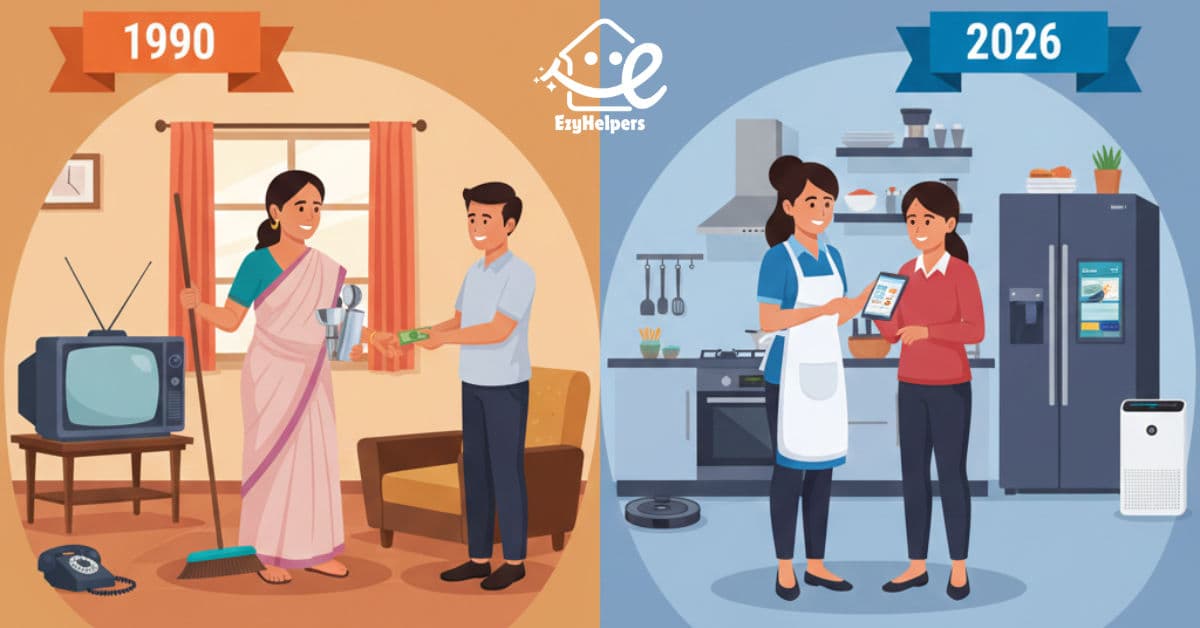
Let's be honest. If you grew up in an Indian household in the '90s, you know exactly how families found domestic help in India. Your mom asked the neighbour aunty, who recommended her own bai, who had a cousin looking for work nearby.
That was the entire "recruitment process."
No background checks. No contracts. No app. Just a network of trust, a little bit of luck, and a prayer that she'd show up on Monday.
Fast forward to 2026, and house maid services in India look almost unrecognisable. The domestic help industry, which was once entirely informal, has undergone a quiet but massive transformation.
From technology-driven platforms to verified house helpers, professional training, and structured work agreements, the way Indian families hire and manage domestic staff has changed at every level.
So how did we get here? Let's take a walk through time.
The 1990s: Domestic Help Was All About Word of Mouth
Back in the 1990s, the concept of a "maid agency" or "domestic staffing company" barely existed in India, especially for middle-class households. Hiring a house helper was deeply personal and almost entirely based on community referrals.
Here's what that world looked like:
- Recruitment happened through neighbours, relatives, or society watchmen.
- There were no written agreements, and verbal understanding was the norm.
- Salaries were paid in cash, often combined with old clothes, leftover food, or festival gifts.
- Domestic workers had no fixed working hours or paid leave.
- Legal protection was almost non-existent.
- Tasks were broadly defined. One person was often expected to sweep, mop, wash utensils, and handle laundry all at once.
For homeowners, things worked as long as the person was reliable. For workers, dignity and job security were limited. The power dynamic was uneven, and both sides simply adjusted.
The 2000s: A Slow Shift Begins
The early 2000s did not bring an overnight revolution, but awareness started growing. Rapid urbanisation meant nuclear families in cities like Mumbai, Delhi, Bengaluru, and Hyderabad became increasingly dependent on domestic help.
With both partners working, reliable full-time support became essential.
Small local maid agencies began appearing in urban neighbourhoods. These were not highly organised businesses and were often run as semi-formal referral services, but they marked an important beginning.
Employers started asking practical questions:
- Where is the helper from?
- Do they have references?
- Are they experienced in childcare or elderly care?
Families slowly began preferring organised solutions like professional house maid services, with trained domestic staff in India, ensuring safer and more reliable support.
At the same time, NGOs and social organisations started raising awareness about domestic workers’ rights and fair wages.
The 2010s: Technology Enters the Picture
The real disruption arrived in the 2010s with India's startup boom. Suddenly, there were apps for everything, including home helper services.
Platforms began connecting verified domestic workers directly with urban households, adding a level of trust that word-of-mouth hiring could never provide.
Major changes during this decade included:
- Identity and background verification are becoming standard practice
- Specialised hiring for cooking, babysitting, elder care, and housekeeping
- Ratings and reviews create accountability
- Growth of part-time home cleaning services
For the first time, domestic work began to be viewed as a professional service rather than an informal arrangement.
Many house helpers gained legitimacy, better earning opportunities, and more consistent employment. Families also started exploring full-time maid services and specialised domestic roles based on their needs.
2026: What House Maid Services in India Look Like Today
Today, the landscape is vastly different and honestly much better for everyone involved.
1. Verified and Trained Domestic Staff
Reputable agencies now conduct background checks, Aadhaar verification, and reference validation before onboarding workers.
Many platforms also provide skill training, including cooking hygiene, safe childcare practices, and elderly care handling, ensuring helpers arrive job-ready.
2. Flexible Hiring Models
Modern households need flexibility, and today’s market delivers it.
Families can hire:
- Part-time helpers
- Full-time maids
- Live-in support
- Hourly or task-based assistance
Many households now prefer live-in maid services for consistent daily support.
3. Digital Platforms and Apps
Finding household staff online is now completely mainstream. From browsing profiles to reading reviews and making payments, everything happens through a smartphone.
This also allows domestic workers to access steady work opportunities instead of depending on a single employer.
4. Worker Rights and Legal Awareness
Awareness around domestic worker rights has grown significantly. Service agreements, notice periods, paid leave, and fair wages are increasingly becoming standard practices.
The push for social security and legal protection continues to gain momentum across India.
5. Post-Pandemic Hygiene Standards
After COVID, hygiene expectations changed dramatically. Employers now ask about vaccinations, sanitisation practices, and health protocols.
Many agencies include health checks during onboarding, something unheard of in the 1990s.
1990 vs. 2026: A Quick Comparison
Here's a side-by-side look at how dramatically the domestic help ecosystem has evolved:
| Aspect | 1990s | 2026 |
|---|---|---|
| Hiring Method | Word of mouth or referrals | Verified online platforms and maid agencies |
| Background Checks | Rarely done | Aadhaar and reference verification have become standard |
| Service Specialisation | General household chores | Cooking, childcare, elder care, and deep cleaning |
| Work Agreements | Verbal understanding | Written contracts with clear terms |
| Payment System | Cash, sometimes irregular | Digital payments and structured salaries |
| Worker Rights | Minimal awareness | Growing legal protections and industry standards |
Why This Evolution Matters
This is not just a story about convenience for employers. It is also a story about dignity for millions of domestic workers across India, most of whom are women working in vulnerable conditions.
When house helper services become professionalised, everyone benefits.
Employers gain reliable and trained support. Workers receive fair wages, safety, and clearer expectations. Indian households get a sustainable system built on mutual respect.
The journey is still ongoing. The future aims toward social security, health insurance, and stronger legal frameworks for every house helper in India.
But the progress made since the 1990s is truly significant.
Ready to Hire Verified Domestic Help?
Finding a reliable house helper no longer has to feel uncertain.
EzyHelpers offers trained, Aadhaar-verified domestic staff with flexible hiring options:
- Part-time support
- Full-time maids
- Live-in helpers
- Replacement assistance