
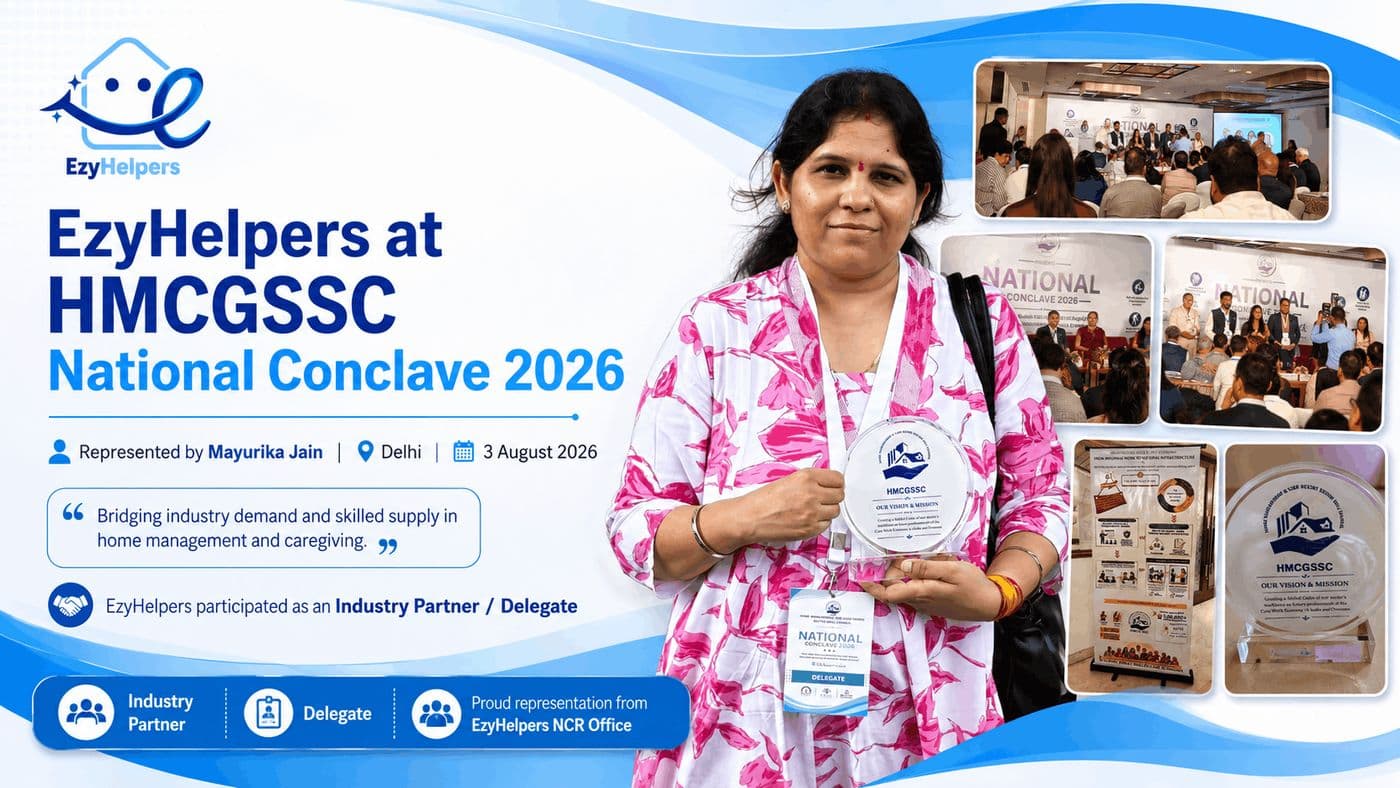
The Home Management and Care Givers Sector Skill Council (HMCGSSC) held its National Conclave 2026 in Delhi on 3 August 2026. Mayurika Jain, from our NCR office, attended as an industry delegate on behalf of EzyHelpers.
The conclave was organised under the leadership of Prof. Mona Gupta, CEO of HMCGSSC, and brought together close to 30 CEOs and senior representatives from caregiving service providers, training organisations and institutions including Apollo. Six panel discussions ran through the day, under the theme of bridging industry demand and skilled supply in home management and caregiving.
What follows is what was discussed and what we think it means for how helpers are trained, placed and treated.
The gap is in trained supply, not in demand
Indian households are asking for more than they used to: home management, elderly care, childcare, patient care, cooking, housekeeping and daily assisted-living support. The number of people willing to do this work has grown. The number who arrive trained, assessed and certified has not kept pace.
The panels returned repeatedly to the same conclusion. Recruiting harder does not close that gap. A worker who has never been shown how a household actually runs will struggle in week one regardless of how many candidates an agency screens. Closing the gap needs structured training before deployment, practical assessment after it, certification that employers recognise, feedback from the households themselves and refresher training when the feedback shows a gap.
For us, this is the most useful thing to come out of the day. Placing more helpers is the easy half. Preparing them is what decides whether the placement lasts.
The word "domestic helper" came up for debate
One panel questioned the terminology the sector has used for decades. The term domestic helper carries social baggage and says nothing about the responsibility involved in running a household or caring for a child, a senior citizen or a patient. Titles such as home hostess, or designations tied to the specific role, were suggested as alternatives.
Language alone changes nothing about pay or conditions. It does affect how a worker is spoken to in a home, how she describes her own work to her family, and whether she sees a career or a stopgap. Those things show up later as confidence, service quality and retention.
Our own position has not changed: a person trusted with the safety and comfort of a household should be treated as a professional, addressed as one, and given somewhere to progress to.
Modern homes need appliance training
A household in 2026 runs on equipment that did not exist in most Indian homes ten years ago. Robotic vacuum cleaners, dishwashers, air fryers, induction cooktops, automatic washing machines, water purifiers, app-controlled devices and smart security systems are now routine in urban flats.
The conclave made a practical case for training helpers on this equipment: how to operate it safely, what basic maintenance it needs and what damages it. Every organised provider knows the cost of skipping this. A damaged appliance is an expensive way for a helper to learn, and it usually ends the placement.
Households in cities like Bangalore expect a helper to walk in and use what is already installed. That expectation is reasonable, and it is on providers and training partners to meet it. See what this looks like in practice on our full-time maid and live-in maid services.
Assessment should happen after placement, not only before
Classroom training tells you what a worker knows. It does not tell you how she performs in a specific home.
The panel recommended a short practical evaluation, roughly two to three days, once a worker is deployed. During that window the household and the provider can observe the things that matter day to day: whether she has understood the routine, whether she can operate the appliances, how she handles hygiene and safety, how she communicates with the family, how she manages time, and whether she fits the household.
Feedback collected in those first days is the cheapest diagnostic available. It identifies a skill gap while it is still fixable with refresher training, instead of six weeks later when both sides have decided the placement failed.
Every home is different, so we treat the first week as part of the placement rather than the end of it.
Communication and presentation are part of the work
Technical skill is one part of the job. A helper works in close contact with children, senior citizens, patients and family members, often for years. Clear communication prevents most of the misunderstandings that turn into complaints.
Basic Hindi and English were identified as useful for employability across regions, with the local language adding value depending on the city. Alongside that, the panels covered workplace etiquette, punctuality, personal hygiene, appropriate dress, following instructions, reporting problems early, and keeping the household's privacy.
Presentation is treated as a superficial subject in this sector. It is a signal. A helper who arrives clean, on time and ready to work is telling the family something about how she will treat their home.
Counselling keeps people in the profession
Caregiving is demanding work, and live-in work more so. Long hours, distance from family, a new city, an unfamiliar language and emotionally heavy situations all come with it, particularly for helpers supporting patients or seniors.
The panel argued for structured counselling and support, and the argument holds up on the employer side too. A large share of placements that break down are not skill failures. They are unresolved grievances, a misread instruction, or expectations nobody stated out loud. A regular check-in surfaces those while they are still small.
This matches what we see in our own placements. Helpers who have somebody to call when something goes wrong stay longer, and the households they work in complain less.
Elderly care needs its own curriculum
India's ageing population is changing what families ask for. Seniors need help with mobility, hygiene, nutrition, medication routines, companionship and daily activity, and caregivers often have to coordinate with family members and doctors.
The training areas the conclave identified for elderly care were specific: personal hygiene assistance, safe transfer and mobility technique, fall prevention, basic emergency response, medication awareness, nutrition and hydration, senior-friendly meals, noticing changes in behaviour or routine, and supporting dignity and independence.
A caregiver is not a substitute for a doctor or a nurse. A trained one supports everyday wellbeing and, more usefully, recognises when something needs medical attention. That single skill prevents hospital admissions. If you are weighing this for your own family, our elderly care service explains what a trained caretaker covers.
Childcare training beyond supervision
Childcare carries the highest responsibility of any household role and the least tolerance for improvisation. The discussions covered child safety, hygiene, age-appropriate nutrition, meal preparation, emergency response, safe handling of infants, supporting daily routines, communicating with parents, and recognising early signs of illness or discomfort.
Families now expect a childcare professional to be verified and trained, not simply available. Structured training and certification are what let a provider back that expectation with something more than a reference. Our nanny and babysitter service is built around that standard.
Certification works only alongside continuous learning
Household expectations, care standards and home technology keep moving. One training programme at the start of a career cannot cover a decade of that.
A working system, as the panels described it, has role-based training before deployment, a practical skills assessment, certification aligned to industry requirements, employer and customer feedback, refresher training, advanced specialisations, recognition for experience, and a defined route to progress.
The last point deserves more attention than it usually gets. An experienced home management professional should be able to move into work as a senior caregiver, a specialist in childcare or elder care, a trainer, an assessor, a placement coordinator or a household operations supervisor. Career paths attract people into the profession and keep them there. Without them, the sector trains workers for someone else to lose.
No single company can do this alone
The clearest message of the day was structural. Industry providers know what households actually ask for and where placements break. Training institutions turn that into curriculum. Skill councils standardise the occupational requirements and the certification. Policymakers can support formalisation, worker protection and the training infrastructure to scale it.
Each of those parts is weak without the others. Training designed without industry input teaches for conditions that do not exist in real homes.
What we are taking back
The conclave lines up closely with the direction EzyHelpers has been working in. Participating as an industry partner commits us to the parts we control: supporting structured training and certification, improving how we assess helpers after placement and not only before it, preparing them for the appliances in modern homes, backing counselling and communication support, strengthening our elderly care and childcare capability, and using professional titles that reflect the work.
Households will keep raising the bar on what a trained, verified helper should be able to do. Helpers will keep raising theirs on respect, pay and where the work leads. Both are reasonable. The work of an organised provider is to hold the two together.
Skill, dignity, trust and collaboration were the four words the day kept coming back to.
Our thanks to HMCGSSC, to Prof. Mona Gupta and to the panellists and industry leaders who made the discussion a concrete one, and to Mayurika Jain for representing EzyHelpers in Delhi.
If you are hiring a trained, verified helper in Bangalore or Bareilly, tell us what your home needs and we will tell you honestly what fits.